Do you really need 10,000 steps per day for health benefits? What the evidence shows
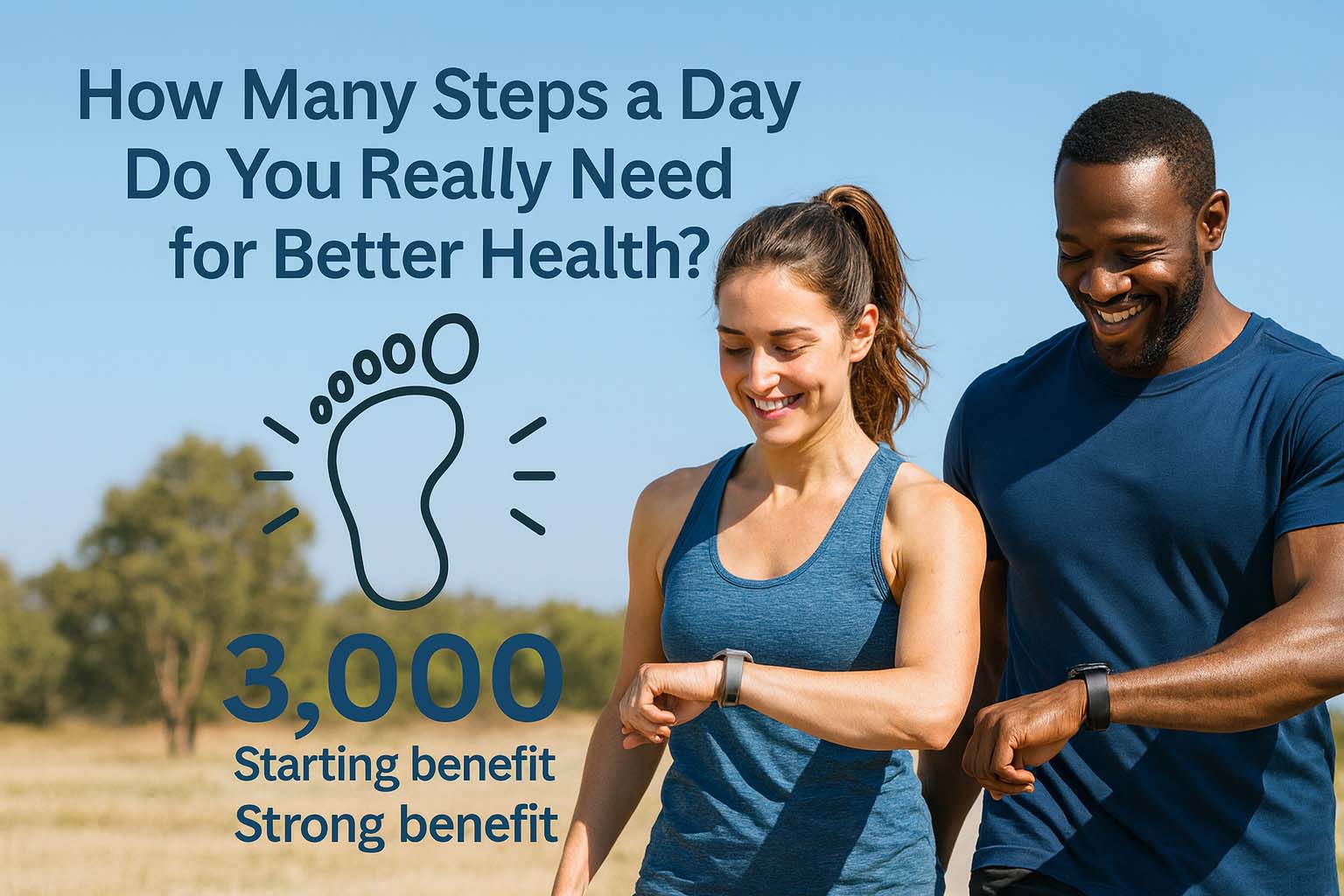
How Many Steps a Day Do You Really Need for Better Health?
At ProData Analytics, we believe good health information should be clear, simple, and free from confusion. Many people have heard that you must walk 10,000 steps a day to stay healthy. But is that really true?
Our Consumer Evidence-Based Review (CEBR) team looked at the latest research. The good news is: you don’t need 10,000 steps a day to get real health benefits. In fact, benefits begin with fewer steps than you might think.
What Does “Steps per Day” Mean?
“Steps per day” is how many steps you take in a whole day — not just during exercise.
Most studies use pedometers, smartwatches, or fitness trackers to measure this.
The question researchers ask is: what is the minimum number of steps needed for health?
Where Do Health Benefits Begin?
Recent studies show:
3,000 steps/day: Health benefits begin here. Even this amount can lower the risk of early death compared to fewer steps.¹
4,000 steps/day: Linked to longer life and reduced disease risk.²
5,000–6,000 steps/day: Benefits keep growing.³
7,000 steps/day: Strong reductions in risk of death, heart disease, diabetes, and depression.⁴ ,6
Over 7,000 steps/day: More steps still help, but the extra benefit starts to slow down.
Other Benefits of Walking More
Walking does more than protect your heart:
Better mood and less depression: Each extra 1,000 steps/day is linked to fewer cases of depression.⁵
Lower chronic disease risk: About 7,000 steps/day is tied to lower risk of heart disease, diabetes, dementia, and cancer.
What This Means for You
If you walk very little now (1,000–2,000 steps/day), adding even a few hundred extra steps each day makes a difference.
Aim first for 3,000 steps/day as a simple, evidence-based starting point.
For stronger benefits, work toward 7,000 steps/day.
Don’t worry if you can’t walk all at once — short walks, errands, or taking the stairs all add up.
Key Takeaway
In 2021, we published a paper in the European Journal of Cardiovascular Nursing that examined the relationship between daily step count cut-points (≤ 5000, 5000- 7499, ≥7500 steps/day) and cardiovascular diseases (CVD) risk in rural residents in Southern United States with high CVD risk. The findings indicate that rural residents who averaged 7500 steps or more per day had lower CVD risk compared to those with lesser steps per day. 6 These findings in consistent with current evidence indicate that you don’t need to reach 10,000 steps to improve your health.
Start with 3,000 steps/day for basic benefits, and aim for 7,000 steps/day for bigger gains. Every step counts toward a healthier life.
At ProData Analytics, our mission is to make evidence clear and useful for everyone. Walking is one of the easiest, safest, and most affordable ways to improve your health — and the science shows it really works.
References
Paluch AE, Bajpai S, Bassett DR, et al. Daily steps and all-cause mortality: a meta-analysis of 15 international cohorts. Lancet Public Health. 2022;7(3):e219-e228. doi:10.1016/S2468-2667(21)00302-9.
Saint-Maurice PF, Troiano RP, Bassett DR, et al. Association of daily step count and step intensity with mortality among US adults. JAMA. 2020;323(12):1151-1160. doi:10.1001/jama.2020.1382.
Kraus WE, Janz KF, Powell KE, et al. Daily step counts for measuring physical activity exposure and its relation to health. Med Sci Sports Exerc. 2019;51(6):1206-1212. doi:10.1249/MSS.0000000000001932.
Dwyer-Lindgren L, Ehrlich JR, Offenbacher R, et al. Step counts and risk of chronic disease: systematic review. Prev Med. 2023;176:107595. doi:10.1016/j.ypmed.2023.107595.
Aino H, Watanabe K, Shibata A, et al. Association between daily step count and risk of depression in adults: a prospective study. JAMA Netw Open. 2023;6(2):e2254009. doi:10.1001/jamanetworkopen.2022.54009.
Madujibeya I, Misook L, Lennie T, Mudd-Martin G, Biddle M, Moser D. 7500 steps per day is associated with lower cardiovascular risk in rural residents with a high prevalence of sedentary lifestyle. European Journal of Cardiovascular Nursing. 2021;20(Supplement_1):zvab060.077. doi:10.1093/eurjcn/zvab060.077
Community feedback
Comments are community feedback and are not part of the reviewed evidence. ProData evaluates submitted sources before changing a review or its conclusions. Comments do not constitute medical advice.
Do not include personal medical information about yourself or anyone else. Comments requesting diagnosis or treatment guidance, or containing identifiable health information, will not be published.
No moderated community feedback has been published for this review version.
Submit feedback for human moderation
Your feedback will be associated with review version 1.0.