

The Challenge: Scarcity of Grant Funding
Why Securing a Grant Is Harder Than Ever
The Harsh Reality of Research Funding
Comparing Past vs Current Success Rates
In the U.S., the competition for research funding has never been tougher:
Early-career faculty face additional challenges, including fewer publications, smaller professional networks, and less institutional influence.
The reality? Even innovative, well-intentioned projects often fail to secure funding without expert guidance.
Why Grant Applications Fail
Five Common Pitfalls That Sink Great Proposals
Poor Funder Alignment
Ideas do not align with the grant's priorities.
Weak Narrative
Reviewers can't easily see the "why" and "how" of a grant application.
Compliance Errors
Missing documents, incorrect formatting, or budget inconsistencies.
Feasibility Concerns
Overly ambitious goals or unclear timelines.
Institutional Gaps
Lack of proven capacity, partnerships, or infrastructure.
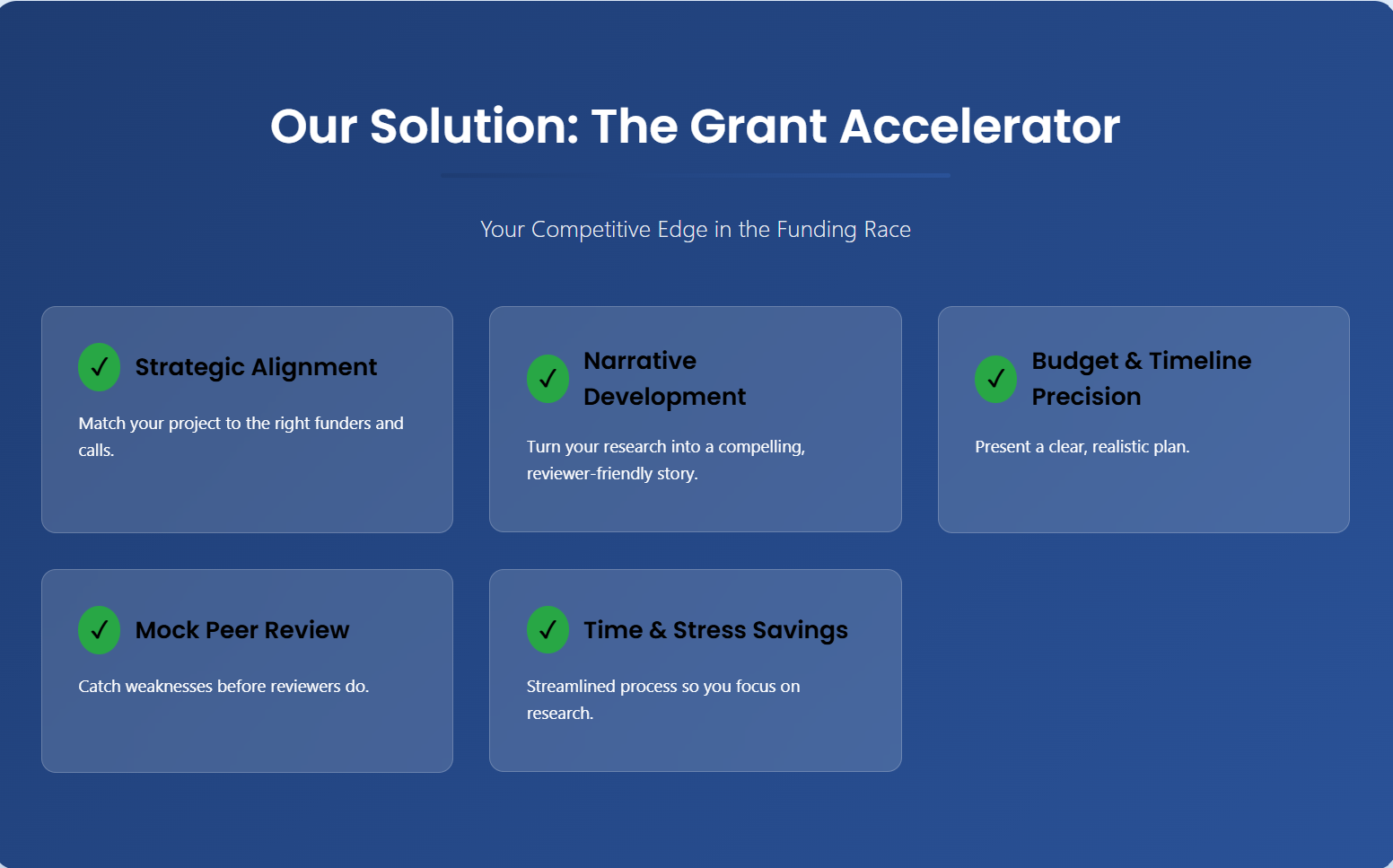
Our Solution: The Grant Accelerator
Your Competitive Edge in the Funding Race
Strategic Alignment
Match your project to the right funders and calls.
Narrative Development
Turn your research into a compelling, reviewer-friendly story.
Budget & Timeline Precision
Present a clear, realistic plan.
Mock Peer Review
Catch weaknesses before reviewers do.
Time & Stress Savings
Streamlined process so you focus on research.
Our Track Story
From First Draft to Fundable—and Publishable
At ProData Analytics, our Accelerator team pairs experienced academicians (former and current PIs, study-section alumni, journal reviewers, and research administrators) with methodologists and statisticians. Together, we bring the two things early-career proposals need most: a crisp "why" (significance and fit) and an operational "how" (feasible approach, defensible methods, aligned budget).
A De-Identified Early-Career Case (Biomedical Sciences)
Starting Point (Week 0)
A first-year assistant professor had a strong idea, but:
- Aims were broad and not tightly mapped to a specific Funding Opportunity Announcement (FOA).
- Methods read at "10,000 feet" (limited power/endpoint detail).
- Budget text didn't mirror the approach (unit costs, Full-Time Equivalent [FTEs], and timelines misaligned).
- Pilot data existed, but weren't framed for a rapid publication to bolster significance.
What ProData Did (Weeks 1–6)
FOA Fit & Aims Rebuild
- Mapped each Aim to the funder's stated priorities and review criteria.
- Wrote an Aims page that reads like a roadmap (Aim → method → metric → milestone).
Approach & Rigor Blueprint
- Specified inclusion/exclusion, primary/secondary endpoints, power/precision, and decision rules.
- Added a risk–mitigation table (trigger → alternative strategy) per Aim.
Budget–Method Reconciliation
- Synchronized methods with a transparent budget justification (quantities, unit costs, roles, and calendar mapping).
Mock Study-Section Review
- Conducted a panel-style read with summary-statement style feedback.
- Addressed "unclear feasibility" and "diffuse significance" flags before submission.
Publication Pathway (Pilot Data → Paper)
- Converted pilot results into a short report with a targeted journal shortlist (scope, indexing, median time to decision).
- Prepared the cover letter, graphical abstract, and response-to-reviewers template.
Evidence You Can Verify
Before/After Artifacts (available for audit with identifying details removed):
- ✓ Revised Aims page, risk mitigation table, power appendix, and budget crosswalk.
- ✓ Pilot-data manuscript package (title page, structured abstract, figures, checklist).
Leading Indicators that matter for young investigators:
- ✓ Internal mock: panel moved the draft from "unclear feasibility" to "discussion-ready" quality.
- ✓ The pilot manuscript was submitted with a planned journal ladder (two backups pre-vetted), strengthening the grant's Significance section.
- ✓ Mentor and collaborator letters of support are standardized to reflect roles, facilities, and data-sharing, which is often a hidden limiter for ECRs.
Outcome snapshot: The researcher entered the next cycle with a submission-ready grant (clean compliance, tighter approach, aligned budget) plus a manuscript under review, materially improving both funding and publication odds. Full de-identified materials and timelines can be shared under NDA upon request.
What Made the Difference (and Will for You)
Experienced Academicians, On Your Side
Review-savvy mentors translate funder language into a clear narrative reviewers can score.
Aims that "Show the Work"
We make your "why" obvious and your "how" inevitable, so feasibility isn't a guess.
Proof on Paper
Every claim in your narrative is backed by a method, a metric, a milestone, and a budget line.
Publication as a Force Multiplier
Turning pilot data into a concise publication (or preprint) elevates Significance and momentum.
Why This Matters for Your Career
Your First Major Grant Is a Career Game-Changer for future funding, reputation, research growth, and tenure.
Ready to Secure Your Funding?
Don't let your research idea be lost in the shuffle. Partner with us to craft a proposal that reviewers can't ignore.
Schedule My Consultation